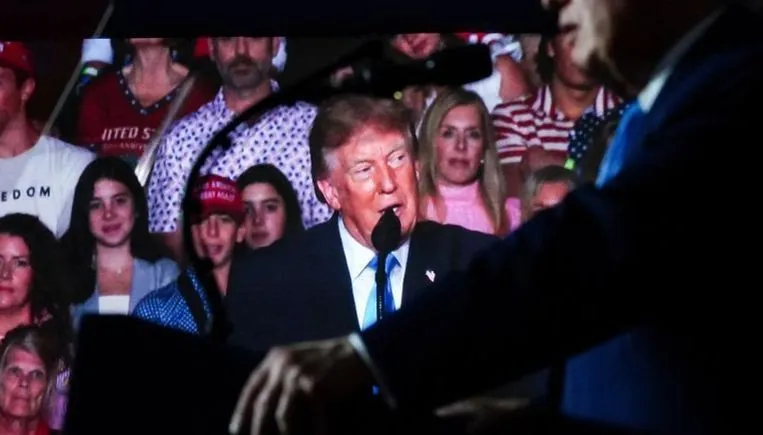
Donald Trump found himself at the center of a firestorm following a campaign stop in Nebraska, where remarks regarding Iran and the potential destruction of major California cities left listeners bewildered. During a rambling sequence of comments, Trump appeared to suggest that letting Iran take out Los Angeles and San Diego would be a small price to pay. The statement immediately triggered a wave of condemnation, drawing sharp rebukes from Democratic senators and even Republican allies, including a GOP congressional candidate from San Diego who expressed vehement disagreement with the idea of writing off American cities as an acceptable cost of war.
Despite the alarming nature of the phrasing, a closer look at the transcript suggests the controversy was born more from linguistic chaos than actual policy intent. Throughout his recent appearances and social media posts, Trump has frequently argued that higher gas prices are a small price to pay to prevent Iran from acquiring nuclear weapons. In several instances over the last few months, he has framed current economic burdens as negligible compared to the horror of a nuclear attack. Just days prior to the Nebraska event, he used almost identical logic during a rally in Alabama, noting that oil prices were far preferable to seeing Mobile targeted by foreign lunatics.
The issue in Nebraska was not necessarily a change in heart, but rather what critics describe as increasing incoherence. As Trump navigated through various topics ranging from Kamala Harris to Venezuelan politics, his sentence structure collapsed, making it sound as though he were permitting an attack rather than comparing its cost to fuel prices. While those familiar with his speaking style might recognize this as part of what he calls his weave—a meandering rhetorical approach designed to circle back to a main point—the result in this instance was nearly impenetrable.
Perhaps most unsettling for observers was the reaction from within the crowd, where some attendees reportedly cheered as the prospect of destroying Western cities was mentioned. Beyond the immediate shock value of the words used, the incident highlights a growing concern regarding clarity and authority coming from one of the most powerful men in the world. Whether viewed as accidental slips or signs of cognitive decline, such fragmented communications carry significant risks when discussing global security and nuclear deterrence.