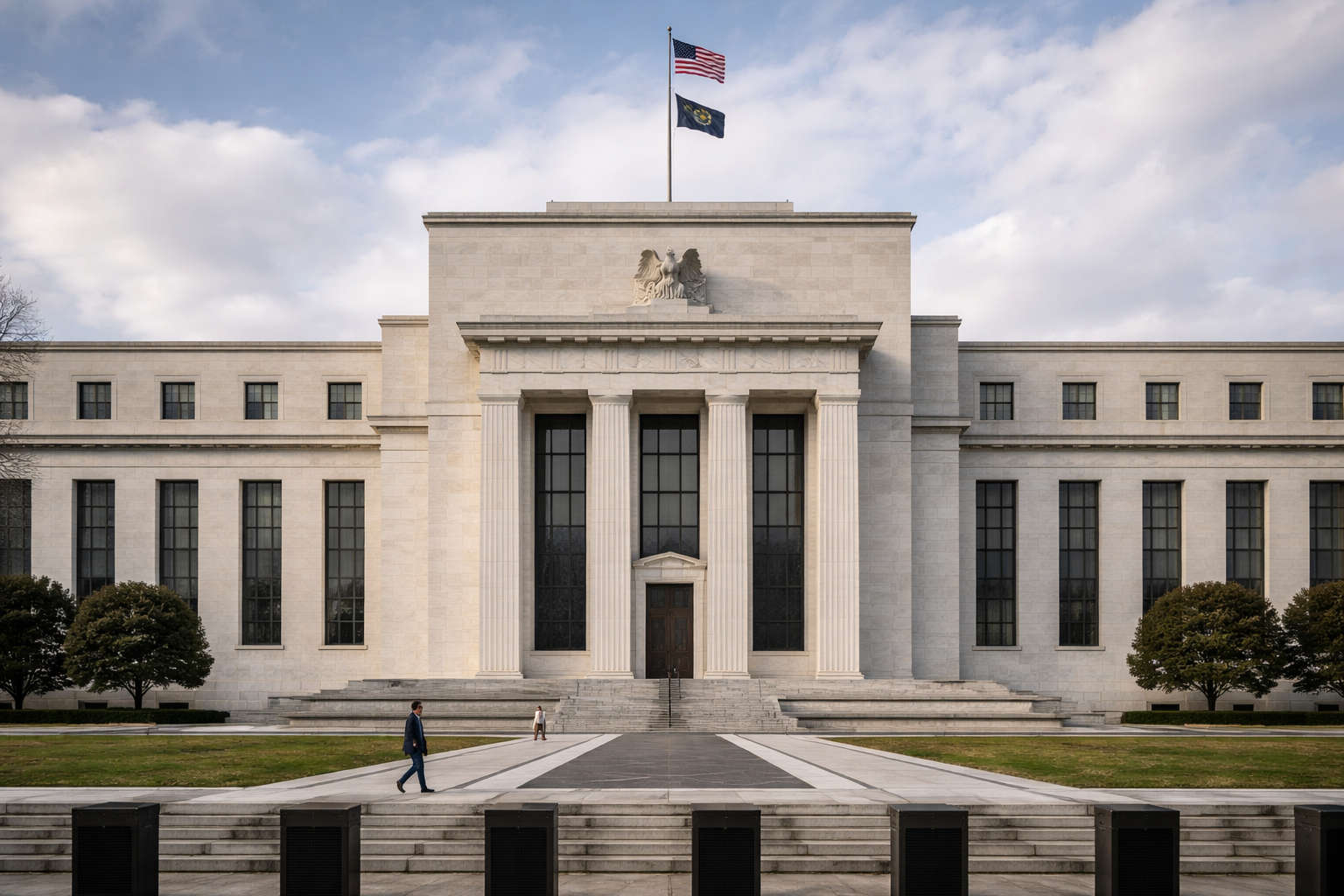
Federal Reserve officials left interest rates unchanged on Wednesday and revealed a growing divide over the future path of monetary policy, as the central bank’s first meeting under new Chair Kevin Warsh highlighted rising inflation concerns and uncertainty over the economic outlook.
The Federal Open Market Committee voted unanimously to maintain its benchmark federal funds rate in a range of 3.5% to 3.75%.
The decision marked the fourth consecutive meeting in which policymakers kept rates unchanged.
Financial markets reacted negatively to the announcement, with Treasury prices falling, the US dollar strengthening, and stocks moving lower.
The meeting also marked a notable shift in Federal Reserve communications.
The post-meeting statement was dramatically shorter than recent releases and removed language that had previously signaled an easing bias toward future rate cuts.
Policymakers divided on future rate path
Updated economic projections showed officials are increasingly split over where interest rates should go next.
According to the Federal Reserve’s “dot plot,” nine policymakers expect at least one quarter-point rate increase this year, with six of those officials projecting at least two rate hikes.
Another nine participants anticipated either no policy change or a rate cut.
Notably, only 18 of the 19 meeting participants submitted projections for rates at the end of 2026.
The missing forecast fueled speculation that Warsh declined to submit a rate outlook.
Warsh has previously criticized the Federal Reserve’s forecasting tools and forward guidance practices.
Market observers have also speculated that he could seek broader changes to the central bank’s communication strategy.
The statement issued after the meeting was significantly shorter than previous releases, containing only 130 words compared with 341 words following the April meeting.
“Economic activity is expanding at a solid pace despite elevated uncertainty that owes, in part, to the conflict in the Middle East. Productivity growth and capital investment are strong,” the statement read. “Job gains have kept pace with the workforce, and the unemployment rate has changed little.”
“Inflation remains elevated relative to the Committee’s 2 percent goal, in part reflecting supply shocks that have driven price increases in certain sectors, including energy. The Committee will deliver price stability,” the committee added.
Inflation outlook rises as growth forecasts ease
Federal Reserve officials significantly increased their inflation projections.
The median forecast for inflation this year rose to 3.6% from 2.7% projected in March.
Policymakers also raised their outlook for core inflation in 2026 to 3.3%, up from 2.7%.
At the same time, officials slightly lowered their economic growth forecast. The median projection for gross domestic product growth in 2026 fell to 2.2% from 2.4%.
The unemployment outlook improved modestly, with policymakers reducing their forecast for the end of 2026 to 4.3% from 4.4%.
Recent inflation data has complicated the policy outlook.
The Federal Reserve’s preferred inflation gauge accelerated to 3.8% in April, while separate measures of consumer and producer prices posted their fastest increases in more than three years.
Strong labor market complicates policy decisions
The economic backdrop facing policymakers has shifted considerably since the start of the year.
Earlier expectations that slowing hiring and moderating inflation would create room for rate cuts have faded as the labor market remained resilient and inflation pressures re-emerged.
Nonfarm payrolls increased by 172,000 in May, while the unemployment rate held steady at 4.3%.
Rising energy costs linked to the conflict involving Iran have contributed to inflation concerns.
However, recent progress toward a preliminary peace agreement between the United States and Iran has pushed oil prices lower and could ease pressure on energy prices if the deal holds.
The post Fed holds rates steady as officials split on hikes under Warsh appeared first on Invezz